
• Skip to main content
  • Skip to secondary menu
  • Skip to primary sidebar
  • Skip to footer
  • ICSE Solutions
    • ICSE Solutions for Class 10
    • ICSE Solutions for Class 9
    • ICSE Solutions for Class 8
    • ICSE Solutions for Class 7
    • ICSE Solutions for Class 6
  • Selina Solutions
  • ML Aggarwal Solutions
  • ISC & ICSE Papers
    • ICSE Previous Year Question Papers Class 10
    • ISC Previous Year Question Papers
    • ICSE Specimen Paper 2021-2022 Class 10 Solved
    • ICSE Specimen Papers 2020 for Class 9
    • ISC Specimen Papers 2020 for Class 12
    • ISC Specimen Papers 2020 for Class 11
    • ICSE Time Table 2020 Class 10
    • ISC Time Table 2020 Class 12
  • Maths
    • Merit Batch

A Plus Topper

Improve your Grades

  • CBSE Sample Papers
  • HSSLive
    • HSSLive Plus Two
    • HSSLive Plus One
    • Kerala SSLC
  • Exams
  • NCERT Solutions for Class 10 Maths
  • NIOS
  • Chemistry
  • Physics
  • ICSE Books

Platonic Solids (Regular Solids, Regular Polyhedra)

December 4, 2020 by sastry

Platonic Solids (Regular Solids, Regular Polyhedra)

Regular Solids 

Regular solids (regular polyhedra, or Platonic solids which were described by Plato) are solid geometric figures, with identical regular polygons (such as squares) as their faces, and with the same number of faces meeting at every corner (vertex). Euclid proved that there are only five regular convex polyhedra.
The five Platonic Solids were thought to represent the five basic elements of the world; earth, air, fire, water, and the universe.
The “regular solids” are important in many aspects of chemistry, crystallography, and mineralogy.

  1. The equilateral triangle is the simplest regular polygon. Placing three equilateral triangles at a vertex (total angle 180°) will form a tetrahedron (4 faces, 4 vertices).
    Platonic Solids (Regular Solids, Regular Polyhedra) 1It has the smallest volume for its surface.
    The tetrahedron represents fire.
  2. Placing four equilateral triangles at each vertex (total angle 240&def;) will form an octahedron (8 faces, 6 vertices).
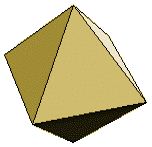
    Platonic Solids (Regular Solids, Regular Polyhedra) 2The octahedron rotates freely when held by its two opposite vertices and represents air.
  3. Placing five equilateral triangles at each vertex (300°) will form an icosahedron (20 faces and 12 vertices).
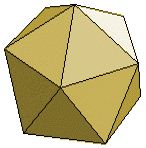
    Platonic Solids (Regular Solids, Regular Polyhedra) 3It has the largest volume for its surface area. The icosahedron represents water.
  4. The second simplest regular polygon is the square. Placing three squares at each corner (270°) will form a cube, or hexahedron (6 faces and 8 vertices).
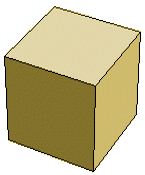
    Platonic Solids (Regular Solids, Regular Polyhedra) 4The hexahedron, standing firmly on its base, represents the stable earth.
  5. The third simplest regular polygon is the regular pentagon. Placing three pentagons at each vertex (324°) will form a dodecahedron (12 faces and 20 vertices).
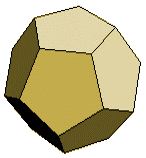
    Platonic Solids (Regular Solids, Regular Polyhedra) 5The dodecahedron represents to the universe since the twelve zodiac signs correspond to the twelve faces of the dodecahedron.

Tidbit of Info:
A soccer ball is composed of a combination of pentagon and hexagon faces. This shape is called a buckyball after Richard Buckminster Fuller, who invented the geodesic dome. In reality, the soccer ball is not truly a polyhedron since the faces are not really flat. The faces tend to bulge slightly due to the amount of stuffing in the ball and the pliable nature of the leather.
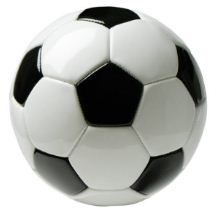
Platonic Solids (Regular Solids, Regular Polyhedra) 6

Filed Under: Mathematics Tagged With: dodecahedron, hexahedron, icosahedron, octahedron, Platonic solids, Regular Polyhedra, Regular Solids, tetrahedron

Primary Sidebar

  • MCQ Questions
  • RS Aggarwal Solutions
  • RS Aggarwal Solutions Class 10
  • RS Aggarwal Solutions Class 9
  • RS Aggarwal Solutions Class 8
  • RS Aggarwal Solutions Class 7
  • RS Aggarwal Solutions Class 6
  • ICSE Solutions
  • Selina ICSE Solutions
  • Concise Mathematics Class 10 ICSE Solutions
  • Concise Physics Class 10 ICSE Solutions
  • Concise Chemistry Class 10 ICSE Solutions
  • Concise Biology Class 10 ICSE Solutions
  • Concise Mathematics Class 9 ICSE Solutions
  • Concise Physics Class 9 ICSE Solutions
  • Concise Chemistry Class 9 ICSE Solutions
  • Concise Biology Class 9 ICSE Solutions
  • ML Aggarwal Solutions
  • ML Aggarwal Class 10 Solutions
  • ML Aggarwal Class 9 Solutions
  • ML Aggarwal Class 8 Solutions
  • ML Aggarwal Class 7 Solutions
  • ML Aggarwal Class 6 Solutions
  • HSSLive Plus One
  • HSSLive Plus Two
  • Kerala SSLC

Recent Posts

  • EQR Certificate (in DRDO Application) | Documents Required, Document and Image Prerequisites
  • 6 Disapproval Letter Samples | Format, Examples and How To Write?
  • DSIR Certificate | Eligibility Criteria, Application Form and Process of Being Certified
  • Georgia Resale Certificate – How To Get and Application Form
  • Caffeine Informative Speech | Informative Speech on Coffee, Advantages and Disadvantages of Caffeine
  • Age Certificate | Online, Format, How to Get Age Certificate? Age Certificate for Pension
  • Disagreement Letter With A False Accusation | Samples. Example and How To Write?
  • Military Payment Certificate (MPC) | Series 521, 481, 681, 692, 641, 661, Design and Value
  • Essay on Labour Day | Labour Day Essay for Students and Children in English
  • National Career Readiness Certificate (NCRC) | Benefits, Requirements, How to Get NCRC?, Validation
  • Labour Day Speech | Speech on Labour Day for Students and Children in English

Footer

  • RS Aggarwal Solutions
  • RS Aggarwal Solutions Class 10
  • RS Aggarwal Solutions Class 9
  • RS Aggarwal Solutions Class 8
  • RS Aggarwal Solutions Class 7
  • RS Aggarwal Solutions Class 6
  • Picture Dictionary
  • English Speech
  • ICSE Solutions
  • Selina ICSE Solutions
  • ML Aggarwal Solutions
  • HSSLive Plus One
  • HSSLive Plus Two
  • Kerala SSLC
  • Distance Education
DisclaimerPrivacy Policy
Area Volume Calculator