Vocabulary Resource
This is a partial listing of basic FORMAL definitions needed when working with Euclidean geometry and proofs.
You need to have a thorough understanding of these terms.
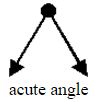
- An acute angle is an angle whose measure is greater than 0° and less than 90º.
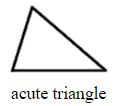
- An acute triangle is a triangle that has three acute angles.
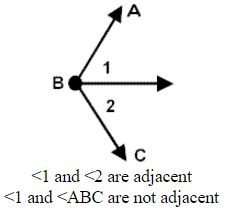
- Adjacent angles share a common vertex, a common side and no common interior points (they do not overlap).
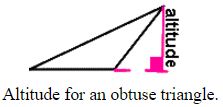
- The altitude of a triangle is a line segment extending from any vertex of a triangle perpendicular to the line containing the opposite side.
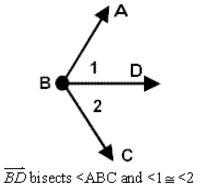
- An angle bisector is a ray whose endpoint is the vertex of the angle and which divides the angle into two congruent angles.
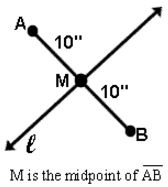
- Bisector of a line segment is any line (or subset of a line) that intersects the segment at its midpoint.
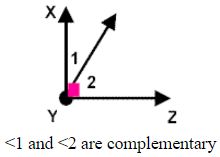
- Complementary angles are two angles the sum of whose measures is 90º. (Complementary angles need not be adjacent angles.)
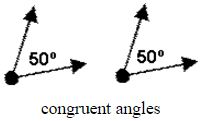
- Congruent angles are angles of the same measure.
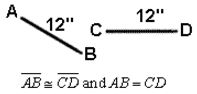
- Congruent segments are segments of the same length (measure).
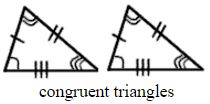
- Congruent triangles are triangles whose corresponding angles and sides are congruent. (They are exactly the same size and shape.)
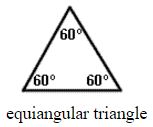
- An equiangular triangle is a triangle which has three congruent angles.
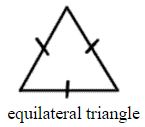
- An equilateral triangle is a triangle with three congruent sides.
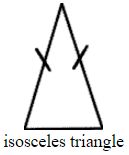
- An isosceles triangle is a triangle with two congruent sides.
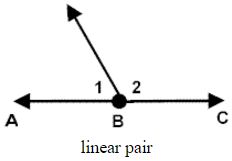
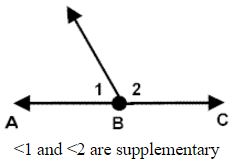
- A linear pair of angles are adjacent angles whose non-common sides are opposite rays (form a straight line). The sum of the measures of the angles in a linear pair is 180º. Unlike supplementary angles, a linear pair MUST be two adjacent angles.
- The median of a triangle is a line segment extending from any vertex of a triangle to the midpoint of the opposite side.
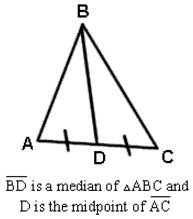
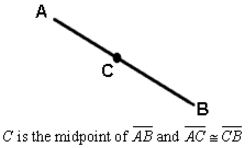
- Midpoint of a line segment is the point on that line segment that divides the segment two congruent segments.
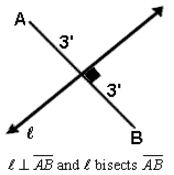
- The perpendicular bisector of a segment is a line (or subset of a line) that bisects the segment and is perpendicular to the segment.
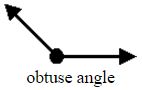
- An obtuse angle is an angle whose measure is greater than 90º and less than 180º.
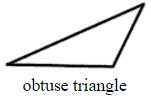
- An obtuse triangle is a triangle which contains one obtuse angle.
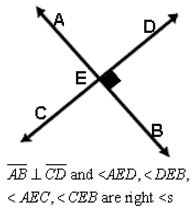
- Perpendicular lines are two lines which intersect to form right angles.
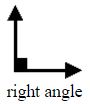
- A right angle is an angle whose measure is 90º.
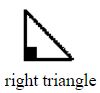
- A right triangle is a triangle containing one right angle.
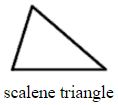
- A scalene triangle is a triangle with no congruent sides.
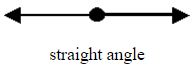
- A straight angle is an angle whose measure is 180º.
- Supplementary angles are two angles the sum of whose measures is 180º. (Supplementary angles need not be adjacent.)
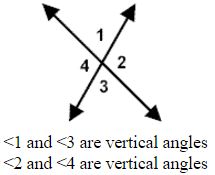
- Vertical angles are two nonadjacent angles formed by two intersecting lines.