
B.Tech Petroleum Engineering, Anna University regulation 2021, awarding the subject code PE3351 deals with the semester III Process Calculations Syllabus. We hope that provide the syllabus in a detailed manner in one place.
Hence this article PE3351 – Process Calculations syllabus, assists in acquiring knowledge regarding the subject. We include required textbooks and references to help you to prepare for academic examinations. Having a grip on the topics will help you to make proper notes, and effective strategies to complete reading the syllabus. It could be a plus point to revise the whole syllabus just by seeing the topics of the syllabus in one place, just by having the screenshots, images, and notes from an effective syllabus page, right? The following article will help you to have that information. Hope it is useful to you. Gain Knowledge and Become Inspirational.
If you want to know more about the syllabus of B.Tech Petroleum Engineering connected to an affiliated institution’s four-year undergraduate degree program. We provide you with a detailed Year-wise, semester-wise, and Subject-wise syllabus in the following link B.Tech Petroleum Engineering Syllabus Anna University Regulation 2021.
Aim Of Objective:
To teach concept of degree of freedom and its application to solution of mass and energy balance equations for single and network of units and introduce to process simulators.
PE3351 – Process Calculations Syllabus
Unit I:
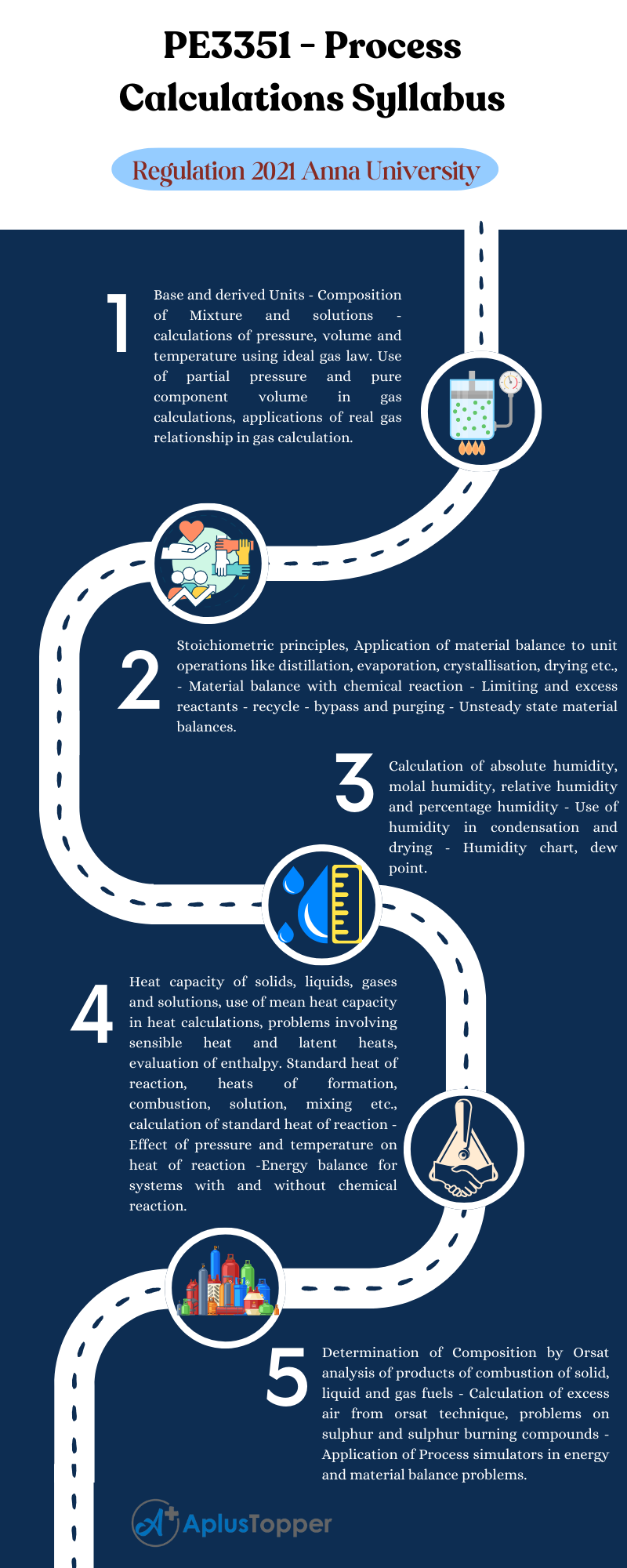
Base and derived Units – Composition of Mixture and solutions – calculations of pressure, volume and temperature using ideal gas law. Use of partial pressure and pure component volume in gas calculations, applications of real gas relationship in gas calculation.
Unit II:
Stoichiometric principles, Application of material balance to unit operations like distillation, evaporation, crystallisation, drying etc., – Material balance with chemical reaction – Limiting and excess reactants – recycle – bypass and purging – Unsteady state material balances.
Unit III:
Calculation of absolute humidity, molal humidity, relative humidity and percentage humidity – Use of humidity in condensation and drying – Humidity chart, dew point.
Unit IV:
Heat capacity of solids, liquids, gases and solutions, use of mean heat capacity in heat calculations, problems involving sensible heat and latent heats, evaluation of enthalpy. Standard heat of reaction, heats of formation, combustion, solution, mixing etc., calculation of standard heat of reaction – Effect of pressure and temperature on heat of reaction -Energy balance for systems with and without chemical reaction.
Unit V:
Determination of Composition by Orsat analysis of products of combustion of solid, liquid and gas fuels – Calculation of excess air from orsat technique, problems on sulphur and sulphur burning compounds – Application of Process simulators in energy and material balance problems.
Text Books:
- Himmelblau, D.M., “Basic Principles and Calculations in Chemical Engineering”, EEE Sixth Edition, Prentice Hall Inc., 2003
- Felder, R. M. and Rousseau, R. W., “Elementary Principles of Chemical Processes”,3rd Edn., John Wiley & Sons, New York, 2000.
- Bhatt, B.L., Vora, S.M., “Stoichiometry “, 4th Edition,Tata McGraw-Hill (2004).
References:
- Hougen O A, Watson K M and Ragatz R A, “Chemical process principles” Part I, CBS publishers (1973).
- Venkatramani. V, Anatharaman. N and Meera Shariffa Begam “ Process Calculations” Printice Hall of India, New Delhi,
- K.V. Narayanan, B.Lakshmipathy,” Stochiometry and ProcessCalculation”, PHI Learning Ltd.(2013).
Related Posts On Semester – III:
- MA3351 – Transforms and Partial Differential Equations
- PE3301 – Geophysics
- PE3302 – Fluid Mechanics and Solid Operations